
Think about something you learned at school and still remember today. It might be a multiplication table, a poem, or a rule your teacher repeated so often that you can still hear their voice.
You might find it difficult to separate the two.
That relationship sits at the centre of a 2016 paper by education researcher David Kember. He examines whether the ways students combine memorisation and understanding could help explain the strong performance of Chinese and East Asian students in international tests.
His argument challenges a familiar assumption: that seeing a student memorise something tells us how deeply they are learning.
Figure summary
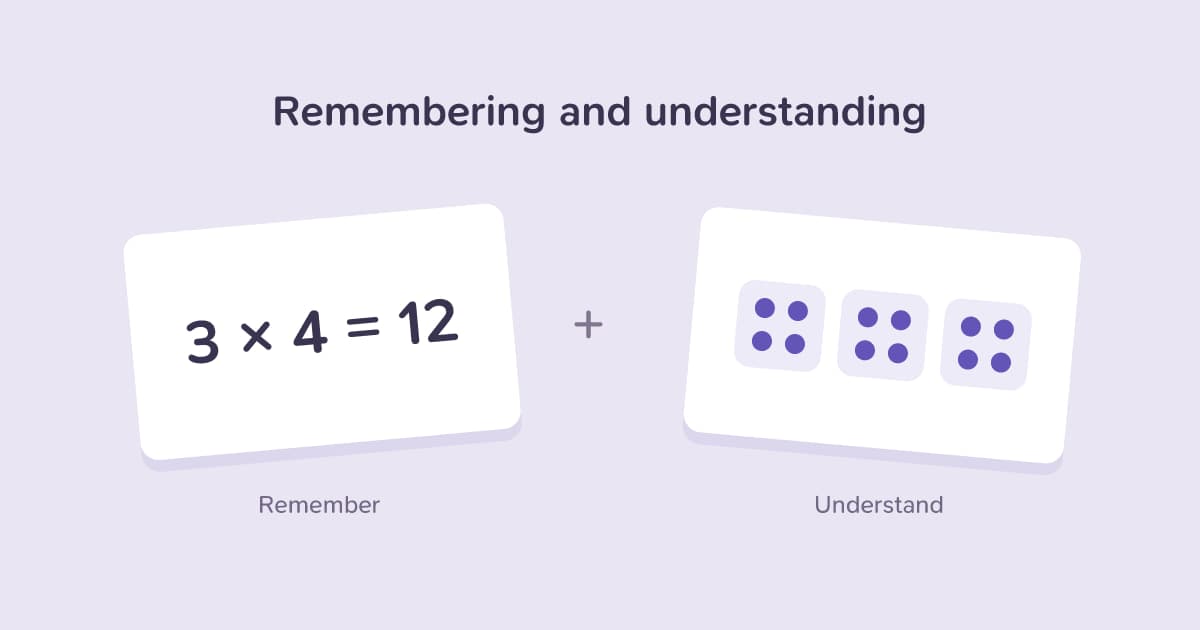
Remembering and understanding can work together. A flashcard shows three times four equals twelve: a fact you can recall. Beside it, three groups of four dots show what the fact means. Both represent the same twelve dots.
Two students, the same formula
Imagine two students preparing for a maths exam. Both spend part of their evening repeating a formula. From across the room, their studying could look much the same.
Student A
Memorises a formula and practises substituting numbers into it.
Student B
Memorises the same formula, explores why it works, and practises deciding when to use it.
An illustration for this article, not an experiment from the paper.
The difference becomes clearer when you look at what they are trying to achieve. One might be preparing to reproduce a familiar procedure. The other is trying to build knowledge they can use in different situations.
That distinction helps explain what researchers called the “paradox of the Chinese learner.”
Chinese students were often portrayed as relying heavily on rote learning. Earlier educational research had associated surface approaches—such as reproducing material without seeking its meaning—with poorer learning outcomes. Yet Chinese students were performing well in academic comparisons.
Kember discusses, among other evidence, the 2012 PISA mathematics results, in which the seven highest-performing participating countries and regions were in Asia. These are the historical results discussed in the paper, rather than today’s rankings.
The apparent contradiction prompted researchers to look more closely. Perhaps some activities that observers had labelled rote learning involved considerably more thought.
What do we mean by memorisation?
You can remember a sentence without knowing what it means. You can also understand an idea and make a deliberate effort to remember it. And you can learn something by heart that later helps you understand something more complicated.
Kember distinguishes these different roles for memory. His review describes several ways students combine remembering and understanding.
- Understand an idea
- Commit it to memory
The paper describes students who seek understanding first and then memorise material to meet assessment demands.
For example: You work out why a formula works, then make sure you can remember it for an exam.
These examples illustrate the approaches; they do not rank them or identify your learning style.
Which approach sounds closest to how you learn?
Your answer may depend on the subject. You might want an explanation before learning a mathematical formula, while being comfortable memorising unfamiliar words and gradually learning how to use them.
This is one reason Kember proposes a continuum of learning approaches. The usual division between “deep” and “surface” learning can miss the different ways memory and understanding interact.
It also matters what the student is trying to do. Repeating a passage to reproduce its exact words is different from returning to it while trying to work out its meaning.
Repetition alone does not guarantee understanding. But the presence of repetition does not tell us that understanding is absent.
Having something to work with
Consider another situation. You are learning a new language. Someone explains how to construct a sentence, and the explanation makes sense. Then you try to say something yourself and realise you cannot remember the words.
What would help: more explanation, a stronger vocabulary, or both?
In this example, the missing words are the immediate obstacle. Remembering vocabulary gives you material to use; understanding sentence structure helps you put it together. The balance depends on what you already know.
Kember uses language learning to illustrate why memorised knowledge can support meaningful learning. Vocabulary and basic grammatical rules give learners material they can work with.
He makes a similar argument about mathematics. Remembering multiplication facts, formulae, and procedures may help students tackle more complex problems. Understanding the underlying principles remains important, especially when a problem differs from those they have practised.
Figure summary
To work out three times fourteen, split fourteen into ten and four. The rectangle has three rows: one part is ten columns wide, the other four. Three times ten is thirty; three times four is twelve. Add thirty and twelve to get forty-two. Remembered facts give you something to use; understanding helps you put them together. This is an example added for this article.
The proposed benefit becomes particularly relevant in a timed test. A student who can recall and use foundational knowledge may have an advantage over someone who has to reconstruct it.
This is the connection Kember explores: students who regularly combine understanding with memorisation may develop a knowledge base that supports their performance.
It is a plausible explanation. The paper does not establish how much of the difference in international test results it accounts for.
What does the classroom reward?
There is another question worth asking: how much of a student’s approach comes from what school asks them to do?
Imagine an examination that rewards answers reproduced almost word for word. Students have a reason to memorise those answers, even if they would prefer to explore the ideas more deeply.
Change the examination so that students must explain their reasoning or apply a concept to an unfamiliar problem, and their preparation may change too.
Kember’s discussion gives teaching and assessment an important role. Learning approaches are responses to particular tasks and environments, rather than fixed characteristics of a cultural group.
The paper also reviews evidence of Western students combining memorisation and understanding. These practices are not exclusive to Chinese learners.
Kember suggests that early experiences of learning Chinese characters may encourage the use of repetition and memorisation. That is a proposed explanation, however, rather than a demonstrated cause of later academic success.
Throughout the post’s central question, “Chinese students” and “students from the West” therefore need careful handling. These are broad categories covering different schools, subjects, experiences, and individuals.
How much does this explain?
The paper offers a possible part of the explanation.
The article brings together earlier studies, including interviews and questionnaire research. It does not report an experiment showing that a particular memorisation method produces higher international test scores. Kember explicitly calls for further research to test the proposed connection.
What evidence would make the argument stronger?
Kember proposes comparing test questions that benefit from a substantial remembered knowledge base with questions that can be solved from first principles. If his explanation holds, the performance advantage should be greater on the former.
This is a proposal for further investigation in the paper, not a result it reports.
Nor does strong performance in those tests answer every question about a good education. The paper does not settle broader questions about creativity or critical thinking.
Its useful contribution is to make us look more carefully at an ordinary learning activity.
When we see students repeating, reciting, or practising, we can ask what they are remembering, what they understand, and what the activity helps them do next.
Return to the thing you remembered at the beginning of this post. Perhaps you understood it immediately. Perhaps its meaning became clearer through practice. Perhaps you can still recite it but have never found a use for it.
Those are different learning experiences, even though all involve memory.
What can we try?
Here are four ways to put the paper’s ideas into practice. These examples are our suggestions; the paper did not test them as a study routine.
Understand, then memorise
Work out why an idea makes sense. Then make an effort to remember it.
Try this: Before learning the formula for a rectangle’s area, draw a grid and count its squares. Then remember: area = length × width.
See why it works10 squares = 10 square unitsRemember the ruleArea = length × width5 × 2 = 10Use the rule for other rectangles.Count the squares to understand the formula. Then remember it for next time. Figure summary
The rectangle has two rows of five squares, making ten square units. Multiplying its length by its width counts the same squares: five times two equals ten. Seeing this connection can help you understand what the formula means before remembering it.
Learn one idea at a time
Work through a topic in small parts. Make sure you understand and remember each part before moving on.
Try this: When learning fractions, first learn what the numerator and denominator mean. Then move on to adding fractions.
Repeat with a question in mind
Return to a difficult passage with something specific to work out.
Try this: Read a paragraph about evaporation again, asking: “What makes the water leave the wet clothes?” Look for the part that answers your question. If it is still unclear, ask for an explanation.
Remember the basics you need
Notice which facts or words you keep needing. Learning them can give you more to work with.
Try this: Before practising how to order a meal in a new language, learn the words for a few foods and drinks. Use them in a simple sentence to place an order.
Read the research
David Kember (2016). Why do Chinese students out-perform those from the West? Do approaches to learning contribute to the explanation? Cogent Education, 3(1), 1248187.
This post is an explanation of the paper. The student scenarios, reader questions, and interactive examples were added for this article; they are not experiments or assessment tools from the study.
The original paper is published under a Creative Commons Attribution 4.0 licence. The interpretation here does not imply endorsement by its author.